


2pm-4pm, 7th January, 2026
Franklin Wilkins Building, King’s College London
Our third session of the PhD Participatory Research Network brought together PhD students from King’s College London, Queen Mary University of London, Imperial College London, Goldsmiths, University of London, and University of the Arts London. The session was co-facilitated by Emma Hayashibara (QMUL) and Alexandria Bartley (QMUL).
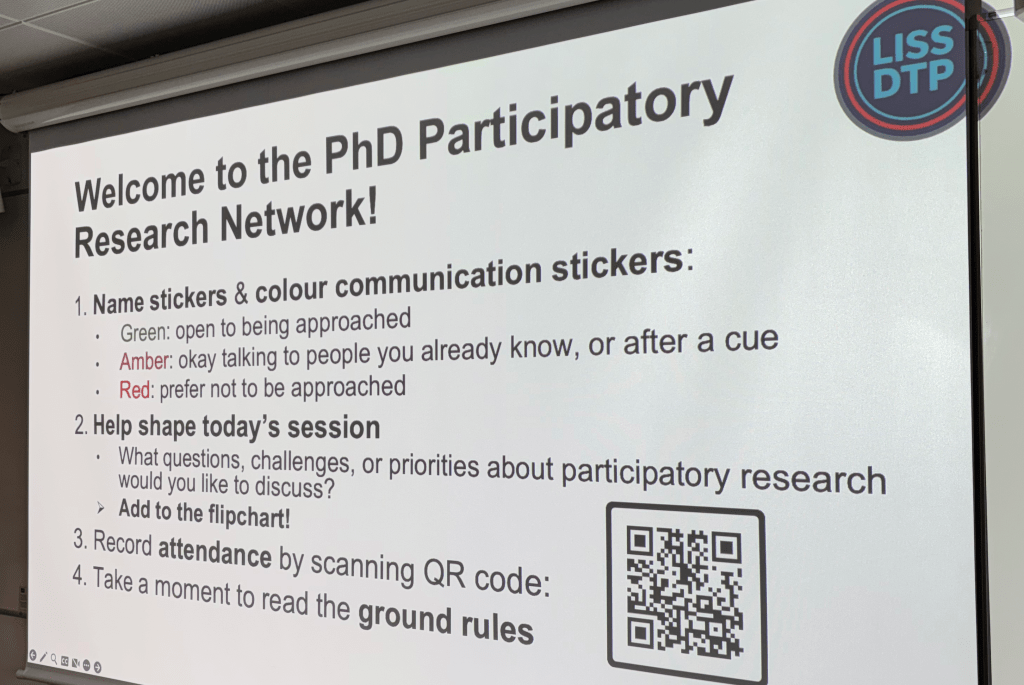
Recap from Session 2
We began with a short recap of Session 2 and opened the floor to reflections from the group. Members shared that Kate’s talk had been particularly helpful, especially her emphasis on remaining flexible, valuing quality over quantity, and being transparent with contributors about evaluations and feedback.
Guest Speaker: Louise Ward
We then welcomed our guest speaker, Louise Ward, a PhD researcher at Bournemouth University and PPIE advisor for Imperial & Partners NIHR Research Support Service/Imperial Clinical Trials Unit. Louise discussed how she’s co-designing her participatory Appreciative Inquiry study with public contributors and the practical lessons learned for PhD-level public involvement and co-production.
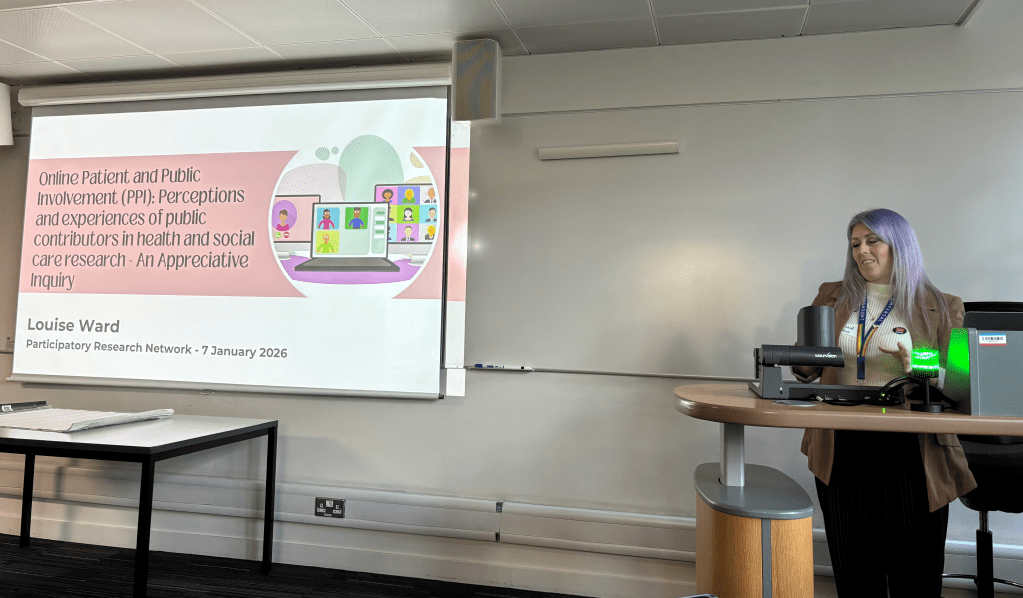
Louise shared her experience of:
- Conducting participatory research as a part-time PhD student, while juggling multiple responsibilities
- Adapting participatory work to move online almost overnight due to COVID-19
- Navigating both the strengths and challenges of online and in-person participatory methods
Louise reflected on why co-design is central to her work, highlighting that it can:
- Improve the quality and relevance of research – research truly can’t be for participants if they aren’t involved
- Enhance transparency and accountability
- Ensure people are given a meaningful voice in research
How Louise co-designs her PhD
Louise described working with:
- A public supervisor, who brings both research knowledge and lived experience
- An advisory group (the LEAP group), which contributes different perspectives and insights
She also reflected on challenges, including:
- Funding difficulties, particularly where public supervisors are not paid staff
- The blurred line between a collaborative project and the reality that the thesis ultimately belongs to the PhD student
Practical tips for co-design
Louise shared several practical tips, including:
- Co-creating the advisory group’s name together
- Considering how the group can contribute at each stage of the PhD (e.g. literature review, ethics, confidentiality)
- Giving contributors a genuine choice about how and where they want to be involved
She also introduced the Appreciative Inquiry 4D Cycle (Cooperrider & Whitney, 2005):
- Discovery – what works well in online PPI?
- Dream – what does the ideal online PPI look like?
- Design – how can we move closer to the ideal?
- Destiny – what can we do for the vision to become a reality?
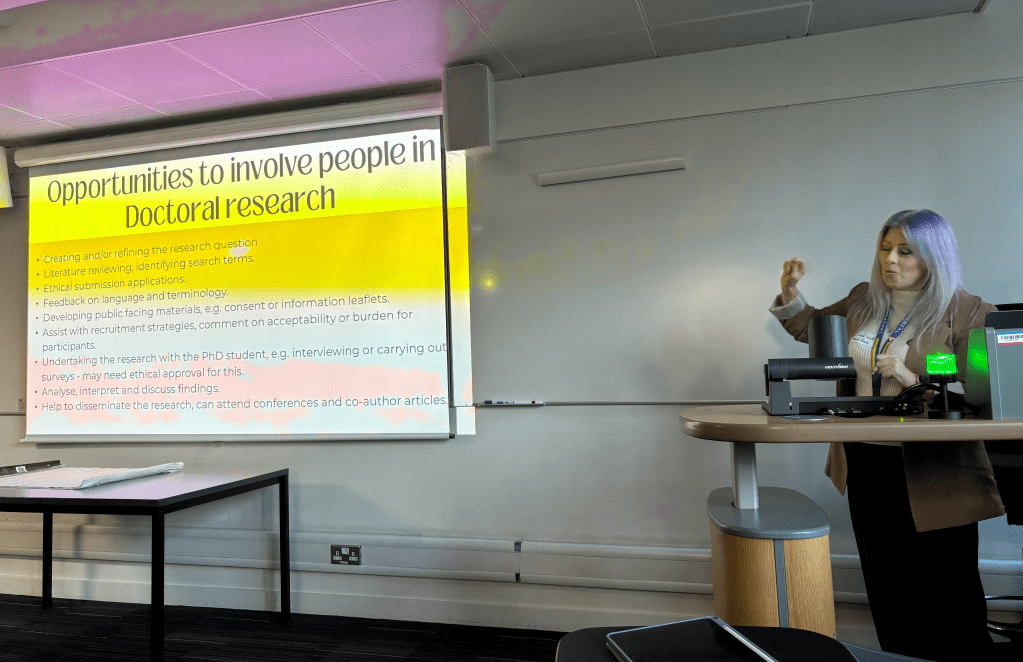
Setting expectations and barriers early
Louise emphasised the importance of being clear from the outset about:
- The extent of influence contributors have in the project
- Budget, timelines, and workload
- The reality that not all ideas can be implemented
Practical Skills for Online Participatory Workshops
Louise also reflected on skills that support participatory research in online spaces, including:
- Facilitation techniques such as reflective listening, managing group dynamics, and establishing emotional safety
- Supporting both yourself as the researcher and the group
- Using online facilitation skills such as warm-up prompts, check-ins, and digital whiteboards
- Creating psychological safety in digital spaces (e.g., ground rules, different ways to contribute, cameras off if needed)
- Reducing digital and cognitive burden (e.g., session length, breaks, materials shared in advance, options to contribute outside meetings)
- Clarifying roles, expectations, and boundaries, including skills and comfort levels
- Helping contributors feel confident using online tools (e.g. Teams, Mentimeter)
- Preparing co-facilitators through pre-meetings and debriefs (e.g., establish clear roles, shared scripts)
- Using creative methods (e.g., story-sharing, future vision exercises, digital mood boards, co-mapping experiences) – many methods are possible even without artistic experience
- Creating a safe space and recognising that this may look different for each person
- Supporting confidence contribution, and voice through reassurance and reflective debrief
Louise also highlighted:
- The importance of starting funding applications early
- Carefully choosing tools rather than assuming they will work
- Starting feedback loops and evaluation earlier in the process
- Separating overlapping roles (e.g. supervisors vs LEAP group)
- Avoiding tokenism – influence does not need to be large to be meaningful
- Working with a small number of contributors – involved early, with continuity and trust
- Setting clear expectations, clear roles, and clear limits
- Allowing space for two-way feedback (i.e., feedback to the group and the group to the PhD student)
- Choosing methods that genuinely support collaboration
- Making space to reflect on the process of participatory research, not just the outcomes
- Acknowledging that everything often takes longer than expected – and planning for this
- Getting the literature review out of the way as early as possible to create space for co-design
Q&A Highlights
Funding and introductions online
Louise shared that building comfort and trust takes time, particularly online. Icebreakers can help, but genuine rapport develops gradually. She provided an example of an icebreaker she often uses – “what’s your favourite food?”
Managing mixed group dynamics
In situations where group members may feel uncomfortable speaking openly (e.g. mixed groups of children and parents, patients and clinicians), Louise suggested adapting formats – including separate sessions – to support honesty and safety.
Disagreements between supervisors and advisory groups
Louise reflected that this is common. For example, a contributor may feel strongly about an idea that a supervisor considers outside the scope of the PhD. In these situations, being transparent about constraints, clearly explaining decisions, and acknowledging the value of contributors’ suggestions can help. She emphasised the importance of saying no kindly and recognising good ideas even when they cannot be implemented, and, where appropriate, keeping a “future projects” log to revisit them beyond the PhD.
From “What brings you here today?” to group discussions
To shape the group discussions, we began with a simple at the beginning of our session. Member were encouraged to write a response to the question “What brings you here today?” on a post-it note and add it to a shared flipchart. This helped surface the key questions and areas of interest that members wanted to explore during the session.
Group discussions: two options
For the group discussions, members were invited to choose between two options, depending on what felt most useful for them.
Option A: Topic of interest
Members could join a group focused on a topic or question that had emerged from the “What brings you here today?” activity. One group chose to focus specifically on working with young people.
Discussions touched on:
- Ethics and parental consent
- Managing dropouts and follow-up, and how to balance persistence with respect for participants’ time
- The need for training when discussing sensitive topics, including how to acknowledge distress while still moving conversations forward
- One suggestion was to have a named contact available during sessions, rather than waiting until after a meeting has ended
- Challenges accessing schools and organisations, especially when contacts drop off or organisations become unresponsive
- Navigating professional roles when entering school spaces, such as entering school spaces as a researcher and former teacher
Members also reflected on broader structural challenges, including:
- Limited time and capacity as PhD students compared to larger projects led by senior researchers
- The difficulty of recruiting through schools for specific or low-prevalence populations
- Whether working with young adults may sometimes be more feasible than working with younger participants
There was discussion around methods, with members noting tensions between more “traditional” approaches (e.g., interviews, focus groups) often encouraged by supervisors and a desire to use more creative, participatory methods. Group composition was also a key theme – particularly whether parents and children, or patients and clinicians, should be involved together or separately. While some saw value in combined sessions at specific points, there was general agreement that this requires careful thought and may not always be appropriate.
Option B: Practice-sharing activity – preparing for participatory workshops
This option offered a more structured discussion space focused on sharing practical experiences of preparing participatory or co-design workshops. Members reflected on:
- What worked well in practice
- What they might do differently next time
- What they wished they had known before starting
Across these discussions, several shared challenges emerged:
- Conducting PPI internationally, where participatory research may not yet be recognised
- This included adapting to different technological infrastructures and expectations
- Supporting contributors with varying levels of digital confidence, particularly in online focus groups
- Members suggested offering opportunities to practise using platforms or tools before sessions begin
- Managing group dynamics, such as dominant voices or clashes between participants
- Setting clear ground rules at the outset was seen as especially important
- Accepting when methods don’t work as planned
- Examples included digital tools or forums that seemed promising but were not taken up by groups, highlighting the need for flexibility and open discussion with contributors
- Networking self as a PhD students – developing a platform as a PhD student as opposed to larger, more established projects
Members also shared examples of what had worked well, such as using visual summaries after meetings, setting clear agendas to structure sessions, and building in preparation time for participants.
There was a shared sense that many of these questions do not have simple answers, and that they require ongoing reflection and collective learning. This reinforced the value of the network as a space to think through these challenges together, rather than in isolation.
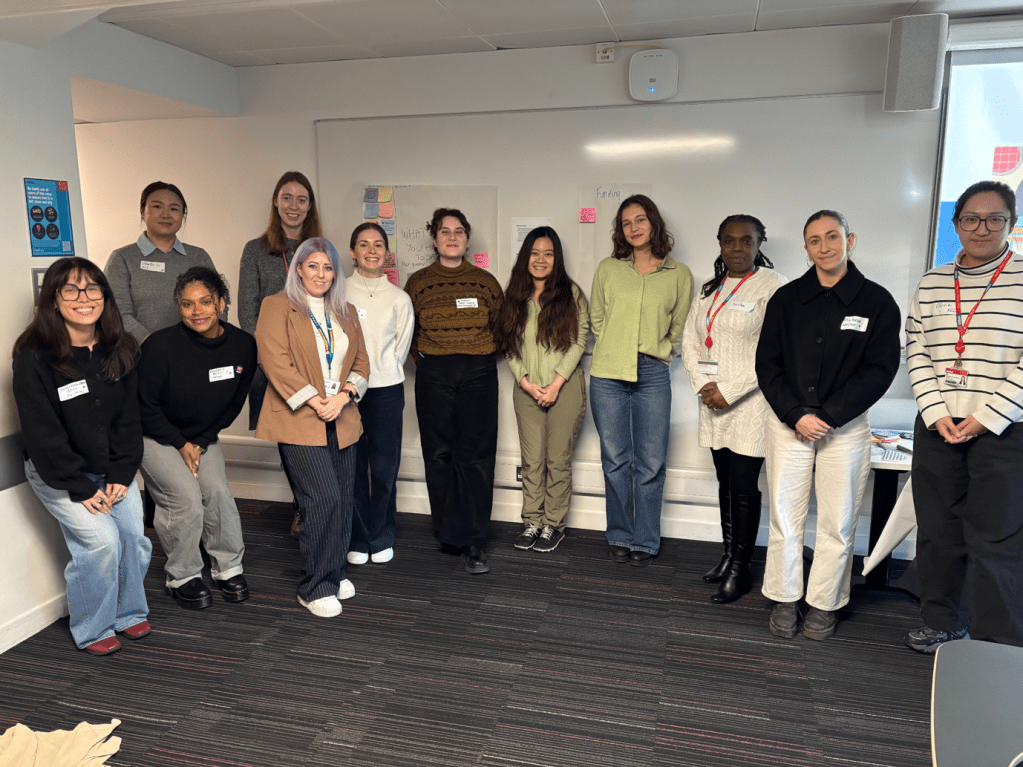
Members closed the session by reflecting on the guilt many PhD students feel when structural constraints prevent research from being as participatory as they would like. This resonated strongly with the group.
Session reflections
- The structure of guest speaker followed by group discussion worked well
- Guest talks helped prompt new lines of reflection
- Flexible session formats supported different needs
- Members suggested creating more space to share external events, talks, or resources
- There was discussion around whether grouping members by research stage might be helpful in future sessions
Registration is now open for the February session of the PhD Participatory Research Network!
Our next session will be held on 4th February, from 2-4pm, in Room 1.62, Franklin Wilkins Building, King’s College London.
Come and join fellow PhD students to explore how participatory values can be embedded in PhD-level research!
 PhD Participatory Research Network
Leave a comment