


2pm-4pm, 4th February, 2026
Franklin Wilkins Building, King’s College London
Our February session of the PhD Participatory Research Network brought together PhD students from King’s College London, Queen Mary University of London, Imperial College London, Goldsmiths, University of London, University of York, University of Surrey, and the University of the Creative Arts.
This session brought a mix of returning and new members. We began with introductions from the committee, followed by a smaller space for network members to introduce themselves, including their name, university and area of research.
Reflections from January 2026 session:
Members highlighted several key takeaways from our previous meeting, including:
- Emphasising “saying no kindly” and setting boundaries
- Navigating complex expectations of others as a PhD student
- Remembering ethical considerations with minors and vulnerable populations
Network Updates:
We shared several upcoming network events and opportunities:
- Launching our Online PhD Participatory Research Surgery on 25th February (1-2pm) (see end of this blog for more info)
- Welcoming Dr. Anne-Laure Le Cunff to our Online PhD Participatory Research Surgery on 18th March (1-2pm)
- Upcoming lunchtime webinar with Katrina Messiha on 15th April (1-2pm), who has kindly adapted her talk to themes suggested by our network – details to follow
Introduction to Youth-Led Facilitation Guidelines
This session was hosted by Dr Lily Gilder, Youth Insight Participatory Research Officer at Queen Mary University of London, and Youth Insight Researchers, Jodi Taylor and Stefania Capraru. Together, they offered a practical and thought-provoking exploration of facilitation, what it is, why it matters, and how it shapes participatory research in practice.
Facilitation is often a neglected area of research training, despite being central to creating safe, inclusive participatory spaces.
- What is facilitation and why does it matter? Creating a safe, supportive space for all to contribute and manage dynamics.
- Why is it important in participatory research? Facilitation influences whose voices are heard and help navigate the sharing of power.
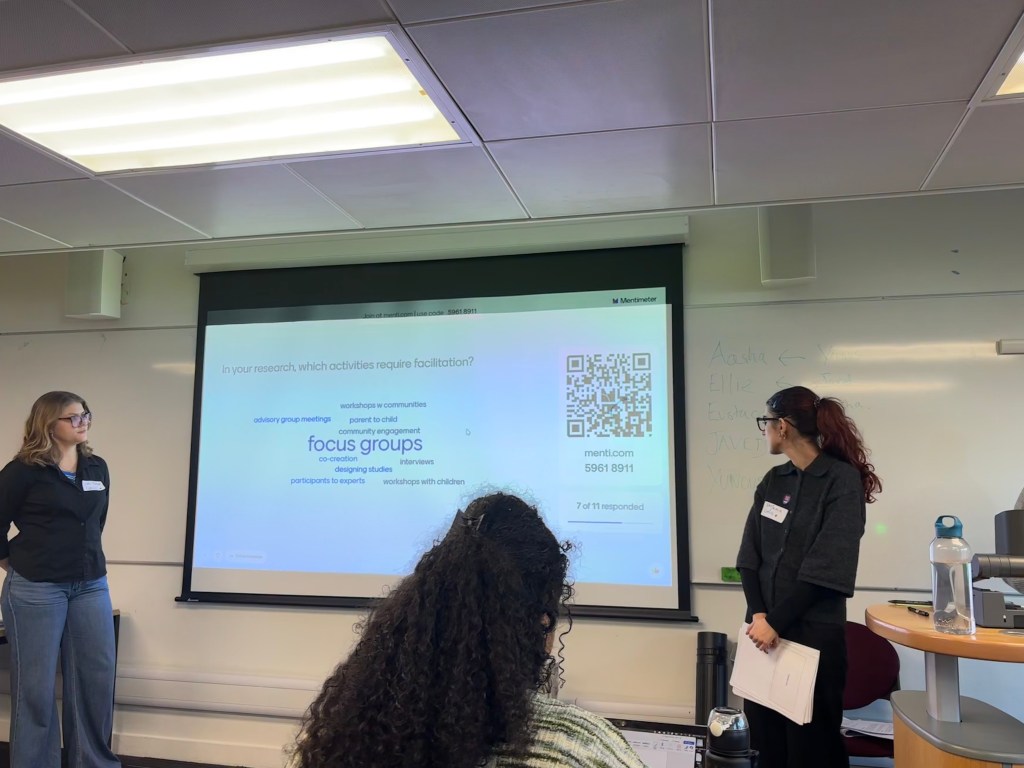
The network contributed to a Mentimeter activity asking: “In your research, which activities require facilitation?”
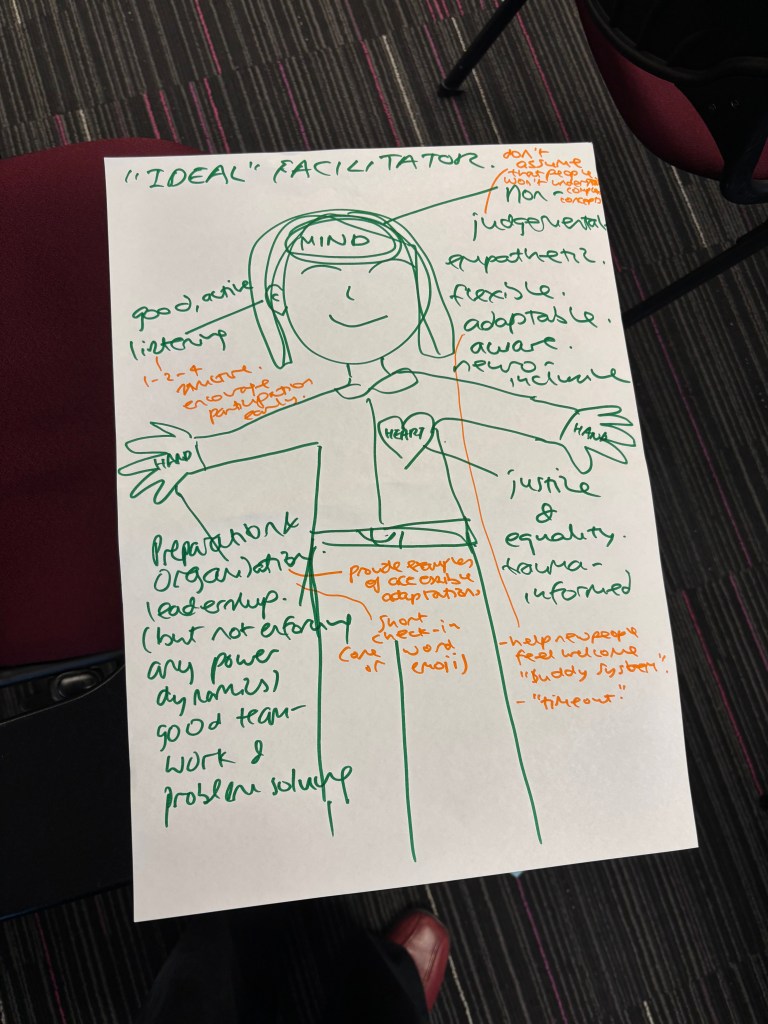
Ideal Facilitator: Drawing Activity
The network participated in an individual activity to think about what an “ideal” facilitator looks like, exploring:
- Mind (what knowledge do they have?)
- Heart (what values do they hold?)
- Hands (what skills do they bring?)
Ideas included empathy, clarity, adaptability, and confidence in managing group dynamics. Members then shared their picture with a partner and practised active listening.
Youth-Led Facilitation Guidelines
Lily, Jodi and Stefania shared their co-developed youth-led facilitation guidelines to the network.
The guidelines are organised around five core themes:
- Respect and boundaries
- Communication and clarity
- Accessibility and inclusion
- Safety and trust
- Participation and power
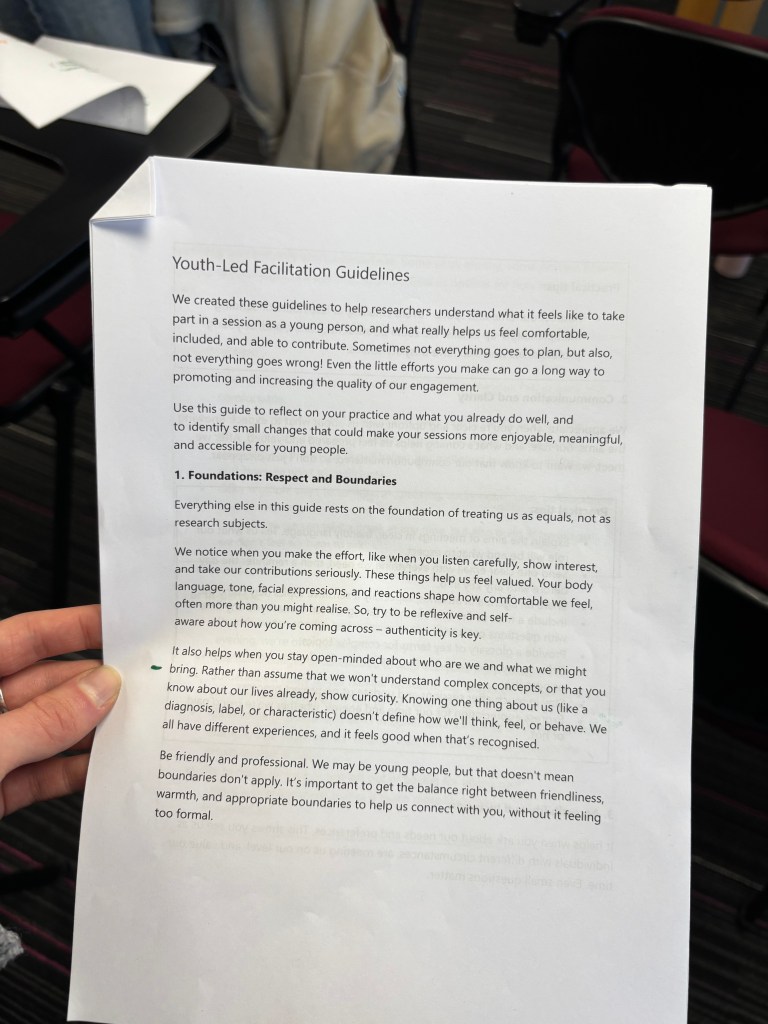
Members reflected on what stood out, what felt most challenging, and how these principles could be applied within their own PhD projects.
Applying the Guidelines in Practice
Members then split into pairs to discuss:
- What aspects of the guidelines they are already using in their projects
- How useful these principles might be in their own work
- How these approaches may be experienced by the young people they work with (or plan to work with)
- What else might support effective facilitation with young people
Members then discussed the same questions in groups of 4 and shared these with the wider network.
Conversations highlighted the importance of open-mindedness (not assuming what young people know), active listening, transparency, and reflexivity, particularly when working across differences in age, expertise, and lived experience.
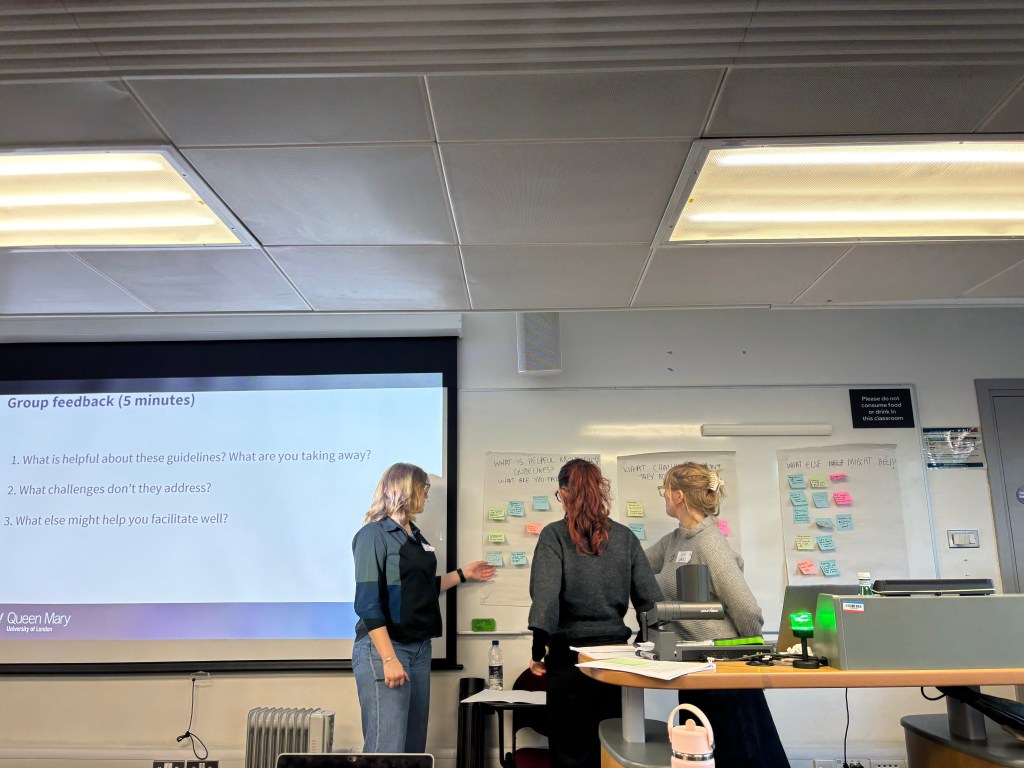
Members reflected on practical tips during these discussions and how they would be useful in their research. Some examples that stood out to members included:
- Starting the session with a short check-in using one word or emoji
- Members reflected that check-in statements like “how are you doing today?” might be too vague at times – having a more set way of checking in would be useful.
- Agreeing on a simple ‘time-out’ signal so anyone can step back or take a break
- Members reflected that participants may not always feel comfortable to say that they’d like to take a break.
Network members then returned to the drawings they created to reflect on which aspects of their “ideal facilitator” were represented in the guidelines, whether the guidelines supported or stretched their current practice, and whether they would help them move closer to the facilitator they want to be.
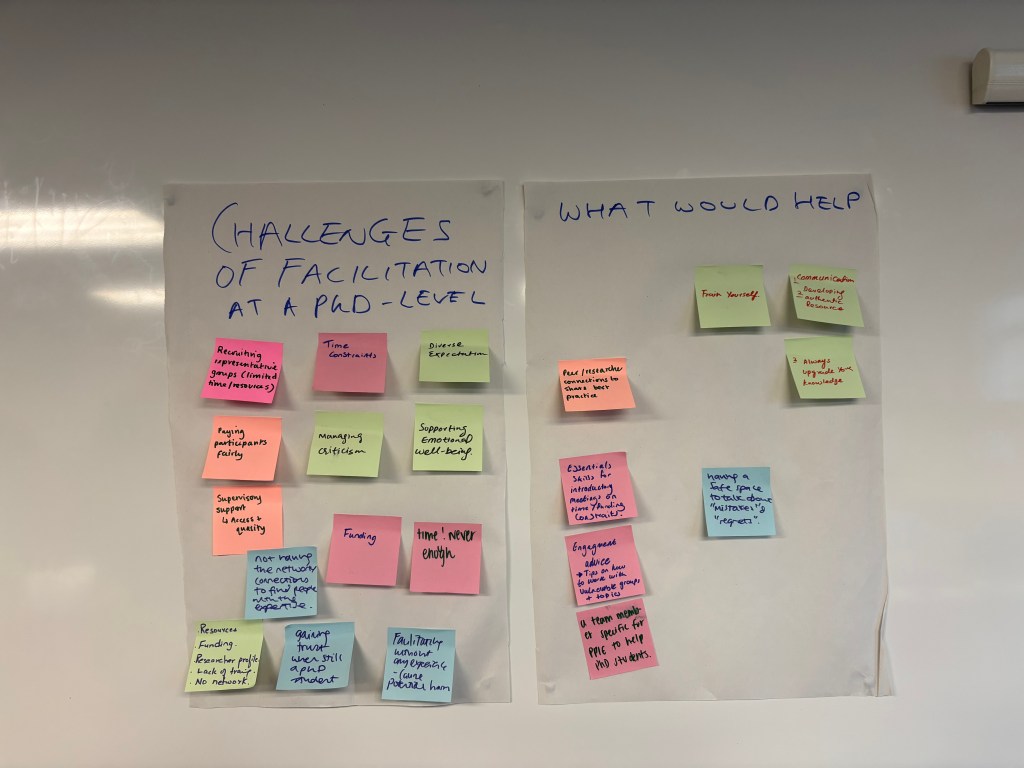
Challenges of Facilitation at PhD Level
Following the workshop, members split into groups to discuss challenges of facilitation within the constraints of PhD research, and what would help.
Key discussion points included:
- Time constraints as a PhD student
- Paying participants fairly
- Diverse expectations within groups
- Supporting emotional wellbeing
- Supervisory support – access and quality
- Recruiting representative groups – limited time/resources
- Lack of funding
- Limited networks or access to facilitation training
- Not having an established researcher profile and having to build trust
- Facilitating without any experience and the risk of being “thrown into” facilitation without adequate support, causing potential harm if not done in a safe way
Two recurring barriers were consistently highlighted for PhD students: time and funding.
What would help:
- Peer connections to share best practice
- Spaces to reflect openly on mistakes, challenges, and learning
- Practical guidance for working with vulnerable groups and sensitive topics
- Support from team members with dedicated PPIE expertise
- Resources tailored to PhD-level constraints
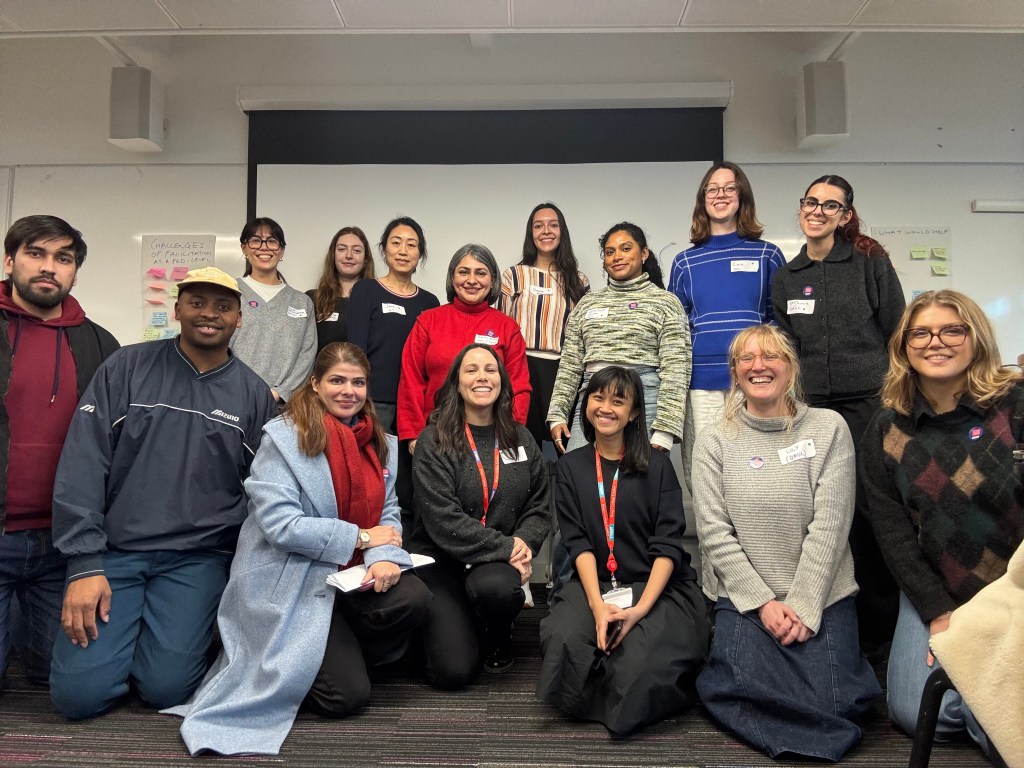
Thank you again to Lily, Jodi, and Stefania for such a thoughtful session, and to all network members for contributing so openly!
Please see below for upcoming network events:
1. PhD Participatory Research Surgery: Online Session on 25th February, 1-2pm (online)
Join us for the first session of our online PhD participatory research surgery – a collaborative space for PhD students to discuss ideas, challenges, and questions about their participatory research projects (or simply a space to connect and vent!).
This session will also be a space to collectively think about how we want to run future surgeries. Sign up via Eventbrite here. The Microsoft Teams link will be sent 24 hours before the session.
2. PhD Participatory Research Network: March Session on 4th March, 2-4pm (in person)
For our March session, we will welcome Dr Aoife Sadlier, who will lead a workshop on the role of creative methods in participatory research, with a particular emphasis on what is feasible to undertake within a PhD.
Spaces are very limited for this session, so please register your interest via Eventbrite here. If you can no longer attend, kindly cancel your registration so that someone else can take your spot.
 PhD Participatory Research Network
Leave a comment