


16th April, 2026
Lunchtime Webinar by Katrina Messiha
Becoming Participatory in Public Health: Theoretical Foundations and Practice of Co-creation
The PhD Participatory Research Network recently welcomed Katrina Messiha, a Social Scientist and a PhD Fellow (Amsterdam University Medical Center) for a lunchtime webinar on co-creation and participatory research in public health. The session was shaped by themes suggested by our network and brought together PhD researchers from the UK, Europe, Australia, South Africa, and beyond.
Katrina’s talk drew on her doctoral research, Theory-based Principles for Co-creation in Public Health, and positioned co-creation not simply as a popular participatory approach, but as a methodological and theoretical challenge in public health research. She argued that while co-creation is now widely used, it remains explicitly theoretically under-specified and is often applied inconsistently. Rather than treating it as a fixed method or universal solution, Katrina framed co-creation as a complex, relational and iterative process that needs to be aligned with the realities of public health complexity.
Katrina started by talking through some of the key terms we often hear in this space (e.g., participation, involvement, engagement, and co-creation) and why they do not mean the same thing. One of the clearest points was that these approaches can entail very different levels or extents of power-sharing, even if they’re sometimes used interchangeably. She also made a helpful distinction between qualitative research and co-creation, pointing out that co-creation may be less about gathering people’s views and more about sharing decision-making.
Katrina also drew an important distinction between qualitative research and co-creation. While qualitative research may entail gathering people’s views, co-creation goes further by engaging stakeholders in shaping decisions, defining priorities and contributing to knowledge production. This helped clarify why participation, involvement and engagement should not automatically be treated as equivalent. Co-creation, in this framing, is not only about listening to people, but about reconsidering who has influence over the research process itself.
A big theme throughout was the need to be careful and specific in how we use participatory approaches. Katrina spoke about some of the common issues in the field, like tokenism, fragmented practice. Rather than assuming co-creation is always the “right” approach, she encouraged us to think more critically about when it actually makes sense to use it. She also noted that the increased interest in co-creation has led to inconsistent and superficial applications, and emphasised that co-creation should not be viewed as a “universal solution”. Moreover, as researchers, we may assume more stakeholder engagement is always better, but Katrina encouraged us to think more carefully about what level of stakeholder engagement actually fits the project, the context, and the related stakeholders’ interests, motivations and capacities.
A particularly useful part of the talk was Katrina’s discussion of when co-creation is actually appropriate. She explained that co-creation may not be needed where a solution already exists and works well, or where a problem can be addressed independently. However, where problems are complex, context-dependent or poorly understood, co-creation can help bring together different forms of knowledge and support the development of more workable, meaningful and context-sensitive solutions. This was a helpful reminder that co-creation requires methodological judgement, rather than automatic application.
Katrina unpacked tokenism not only as a problem of superficial engagement, but as something that can have real consequences for participants and co-creators. She noted that when people are invited into research without genuine influence, this can lead to disappointment, mistrust and what has been described as the “dark side” of co-creation. This point was especially valuable because it moved the discussion beyond simply advocating for more participation and towards asking whether participation is meaningful, honest and appropriately designed.
Another big theme throughout Katrina’s talk was the importance of considering theory. One of the main messages was that participatory research often doesn’t make its theoretical foundations very visible. The main key takeaway message was: if we’re using theory, we should say so clearly, explain why, and show how it’s shaping what we do, and don’t just leave it in the background.
Katrina’s emphasis on theory was one of the strongest parts of the webinar. Drawing on her systematic review of contemporary theories used in co-creation, co-design and co-production in public health, she explained that from nearly 5,000 screened papers, only 10 explicitly used theoretical underpinnings. She used this finding to show that the lack of theory in co-creation is not just a conceptual issue, but an empirical gap in the evidence base. Theory, she argued, matters because it can guide intervention design, inform methods such as interview guides and evaluations and make research more transparent, reproducible and cumulative.
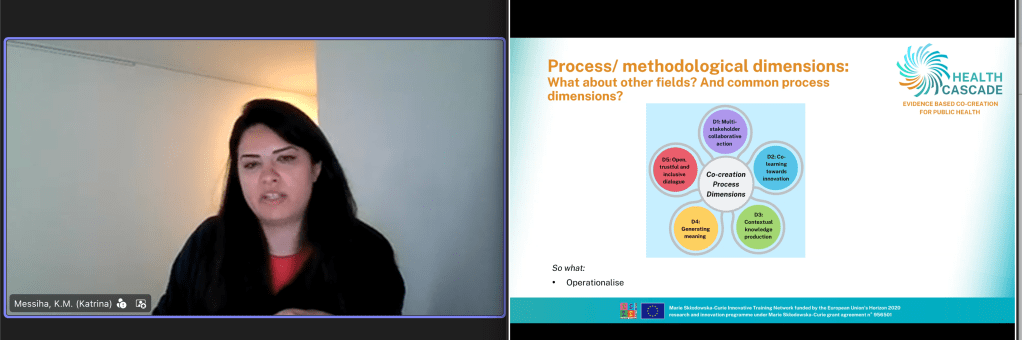
Katrina also showed how co-creation research can benefit from looking beyond public health. Drawing on her cross-disciplinary work, she discussed common process dimensions of co-creation, including multi-stakeholder collaborative action, co-learning towards innovation, contextual knowledge production, generating meaning and open, trustful and inclusive dialogue. These dimensions were presented as practical ways of thinking through how co-creation actually happens, how it is experienced and how it can be communicated more clearly in research.
Another distinctive contribution of the webinar was the discussion of critical realism as a promising methodological lens for public health co-creation. Katrina explained that critical realism can help researchers look beyond what is immediately visible and consider the underlying mechanisms shaping public health outcomes. Rather than understanding causality in a simple or linear way, this approach asks how social, political, institutional and relational factors interact in particular contexts. This offered a valuable way of thinking about how co-creation can support deeper causal understanding, rather than remaining at the level of surface-level participation.
She also addressed the realities of how messy co-creation can be in practice. It doesn’t tend to follow neat steps, and instead relies a lot on relationships, trust, and flexibility, especially when working with marginalised communities. She shared examples from her University of Cambridge work on dementia and healthcare access, showing how participatory approaches can surface barriers that might otherwise be missed using traditional methods.
In the dementia case study, Katrina showed how co-creation can reveal barriers that may remain less visible through more traditional research methods. These included fragmented health and welfare systems, delayed diagnosis, rigid eligibility criteria, inaccessible information, stigma, distrust, fear of being judged or surveilled and suspicion towards institutions and researchers. The case study demonstrated that trust is not something researchers can assume; it has to be actively built through authenticity, transparency, continuity and flexible forms of engagement.
Katrina’s discussion of Youth Participatory Action Research further illustrated the practical tensions involved in participatory work. She emphasised that equitable engagement cannot be assumed simply because a project uses participatory language. Instead, researchers need to actively manage power dynamics, create safe and welcoming environments and consider whether young people are being treated as data sources or as genuine decision-makers. This was a useful reminder that participatory approaches require ongoing reflexivity, not only good intentions.
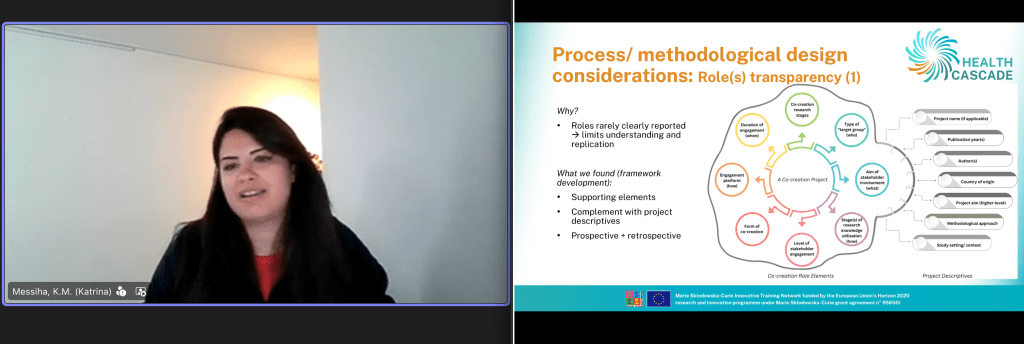
Katrina also introduced the importance of role transparency in co-creation research. She explained that clearly reporting stakeholder roles is not only about giving credit, but also about understanding how knowledge was produced, how decisions were made and how participatory processes can be planned, evaluated or replicated. Her framework was presented in its utility for both prospective application, for negotiating roles and responsibilities with co-creators, and retrospectively, for analysing and reporting what happened during a project.
In the Q&A, we spoke about “insider researchers” (i.e., people researching topics they also have lived experience of) and how they fit within participatory approaches. Katrina described this as an open question, depending on the different “hats” a researcher holds, and suggested that greater representation can be a strength, but isn’t the same thing as co-creation on its own.
Overall, the webinar encouraged us to move from a general enthusiasm for participation towards a more careful and rigorous understanding of co-creation. Katrina’s central message was that co-creation should be defined clearly, theoretically grounded, designed with attention to context and power and reported transparently. For PhD researchers, this offered a valuable framework for thinking not only about how to engage stakeholders, but also about why, when and under what conditions participatory research can produce meaningful knowledge. Thank you so much, Katrina for a fantastic talk!
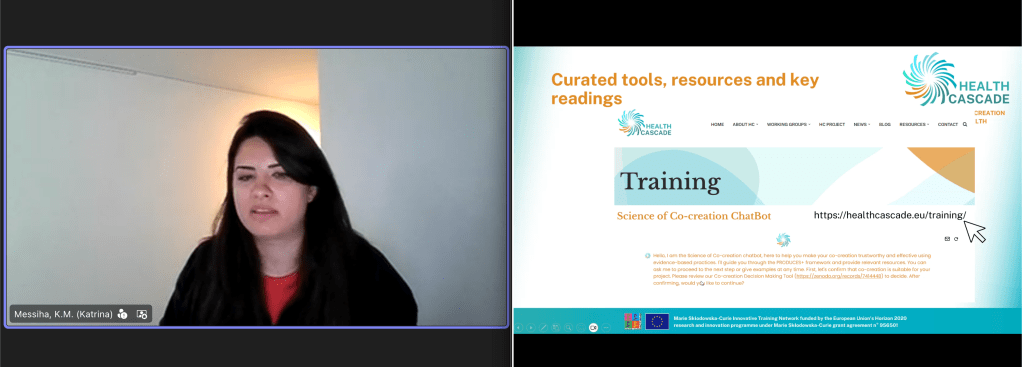
Curated tools, resources, and key readings kindly shared by Katrina:
- Health CASCADE (Marie Skłodowska Curie Innovative Training Networks project funded by the European Union) blog: https://healthcascade.eu/blog/
- Science of Co-creation ChatBot: https://healthcascade.eu/training/
- Co-creation Masterclass Episodes: https://healthcascade.eu/resources/recordings/
Most recent peer-reviewed publications by Katrina:
Messiha, K., Chinapaw, M.J., Ket, H.C., An, Q., Anand-Kumar, V., Longworth, G.R., Chastin, S. and Altenburg, T.M., 2023. Systematic review of contemporary theories used for co-creation, co-design and co-production in public health. Journal of Public Health, 45(3), pp.723-737.
Messiha, K., Altenburg, T.M., Schreier, M., Longworth, G.R., Thomas, N., Chastin, S. and Chinapaw, M.J., 2024. Enriching the evidence base of co-creation research in public health with methodological principles of critical realism. Critical Public Health, 34(1), pp.1-19.
Messiha, K. and Stokes, G., 2024. A Qualitative Study on the Contemporary Perspectives and Experiences of Co-residence During COVID-19 Among “Boomeranging” Young Adults and Their Mothers in England. SAGE Open, 14(4), p.21582440241307473.
Messiha, K., Altenburg, T.M., Giné-Garriga, M., Chastin, S. and Chinapaw, M.J., 2025. Enriching the Existing Knowledge About Co-creation: Identifying Dimensions of Co-creationUsing Explicit Theory in Various Research Fields. Minerva, pp.1-24.
Messiha, K.*,Thomas, N.*, Brayne, C., Agnello, D.M., Delfmann, L., Giné-Garriga, M., Lippke, S. and Downey, J., 2025. Grey literature scoping review: a synthesis of the application of participatory methodologies in underrepresented groups at an elevated risk of dementia. BMC Medical Research Methodology, 25(1), p.122.
Messiha, K., Chinapaw, M.J., Chrifou, R., Deforche, B., Pehlivan, T., Strating, G., Verloigne, M. and Altenburg, T.M., 2026. Key considerations in applying youth participatory action research: elicited insights from international academics and practitioners-a health CASCADE study. International Journal of Adolescence and Youth, 31(1), p.2645826.
Agnello DM*, Loisel QEA*, An Q, Balaskas G, Chrifou R, Dall P, de Boer J, Delfmann LR, Giné-Garriga M, Goh K, Longworth GR, Messiha K, McCaffrey L, Smith N, Steiner A, Vogelsang M, Chastin S., 2023. Establishing a health CASCADE–curated open-access database to consolidate knowledge about co-creation: novel artificial intelligence–assisted methodology based on systematic reviews. Journal of medical Internet research, 25, p.e45059. *co-first authors.
An, Q., Sandlund, M., Lundell, S., Kuenen, C., Chastin, S., Helleday, R., Messiha, K., Loisel, Q. and Wadell, K., 2025. Transition design: Co-creating system solutions for chronic obstructive pulmonary disease (COPD) care. Design Studies, 98, p.101297.
Anand-Kumar, V., Schreier, M., Bakshi, N., Messiha, K., Longworth, G.R., An, Q., Angello, D.M., Chastin, S. and Lippke, S., 2025. Facilitators and challenges of co-creating digital public health interventions: A Health CASCADE multi-case exploratory study. Public Health, 247, p.105847.
Chastin, S.F.M., Smith, N., Agnello, D.M., An, Q., Altenburg, T.M., Balaskas, G., de Boer, J., Cardon, G., Chinapaw, M.J.M.,Chrifou, R., Dall, P.M., Davis, A., Deforche, B., Delfmann, L.R., Giné-Garriga, M., Goh, K., Hunter, S.C., Leask, C.F., Lippke, S., Loisel, Q.E.A., Longworth, G.R., McCaffrey, L., Messiha, K., Morejon, S., Pappa, D., Papadopoulos, H., Ryde, G.C., Sandlund, M., Schreier, M., Steiner, A., Verloigne, M., Vogelsang, M., Wadell, K., (2025). Principles and attributes of evidence-based co-creation: From naïve praxis toward a trustworthy methodology-A Health CASCADE study. Public Health, 248,p.105922.
Chrifou, R., Focquaert, F., Messiha, K., Ghaly, M., Altenburg, T., Deforche, B. and Verloigne, M., 2025. The meaning of ethical collaborative research according to young people. International Journal of Adolescence and Youth, 30(1), p.2517099.
Delfmann, L.R., de Boer, J., Schreier, M., Messiha, K., Deforche, B., Hunter, S.C., Cardon, G., Vandendriessche, A. and Verloigne, M., 2025. Experiences with a co-creation process to adapt a healthy sleep intervention with adolescents: A Health CASCADE process evaluation. Public Health, 241, pp.69-74.
Longworth, G.R., Goh, K., Agnello, D.M., Messiha, K., Beeckman, M., Zapata-Restrepo, J.R., Cardon, G., Chastin, S. and Giné-Garriga, M., 2024. A review of implementation and evaluation frameworks for public health interventions to inform co-creation: a Health CASCADE study. Health Research Policy and Systems, 22(1), p.39.
McCaffrey, L., McCann, B., Giné-Garriga, M., An, Q., Cardon, G., Chastin, S.F.M., Chrifou, R., Lippke, S., Loisel, Q., Longworth, G.R., Messiha, K., Vogelsang, M., Whyte, E., Dall, M.P., 2024. Adult co-creators’ emotional and psychological experiences of the co-creationprocess: a Health CASCADE scoping review protocol. Systematic Reviews, 13(1), p.231.
McCaffrey, L., McCann, B., Giné-Garriga, M., An, Q., Cardon, G., Chastin, S.F.M., Chrifou, R., Lippke, S., Loisel, Q., Longworth, G.R. and Messiha, K., Vogelsang, M., Whyte, E., Dall, M.P., 2025. Co-creationexperiences among adults in diverse contexts: A Health CASCADE scoping review. Public Health, 238, pp.29-36.
For other publications by the project: https://healthcascade.eu/publications/
Katrina’s LinkedIn: https://www.linkedin.com/in/katrinamessiha/
Katrina’s ResearchGate: https://www.researchgate.net/profile/Katrina-Messiha


Leave a Reply