


2pm-4pm, 6th May, 2026
Franklin Wilkins Building, King’s College London and MS Teams
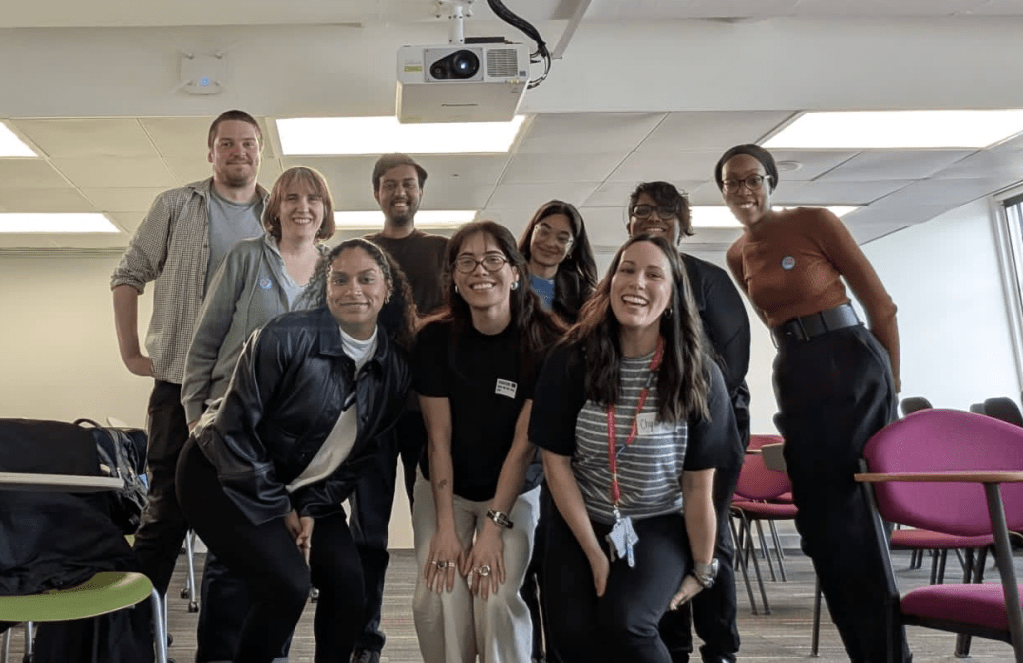
Our May session of the PhD Participatory Research Network was our second hybrid session, bringing together both returning and new members. During this session, we welcomed PhD students from King’s College London, Queen Mary University of London, Goldsmiths University of London, Oxford Brookes, Durham University, University of East London, Nottingham Trent, Birbeck, Brunel and University of Lincoln, Birmingham, Glasgow, Greenwich and Calgary.
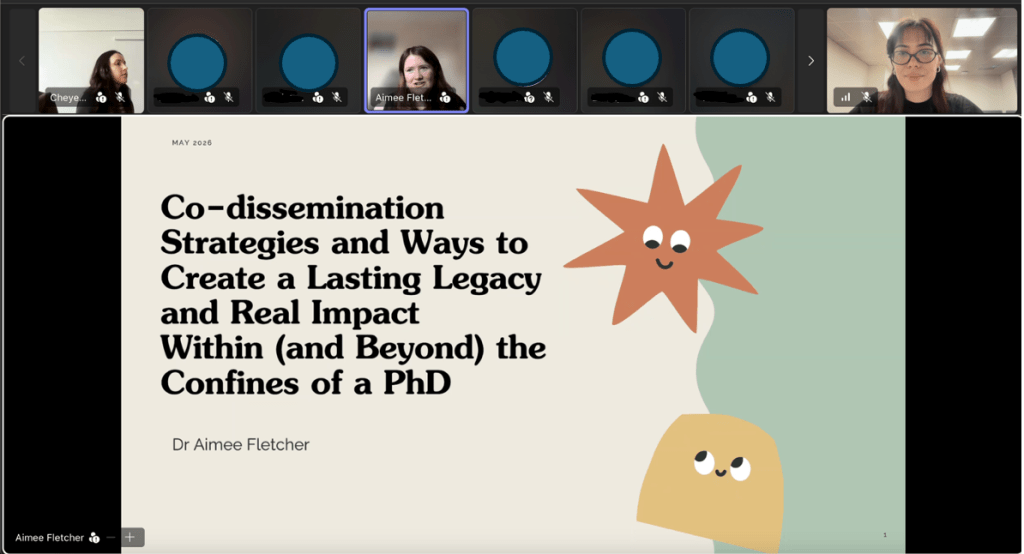
Co-Dissemination and Impact
This session was led by Dr Aimee Fletcher, a recent PhD graduate and Participation Coordinator at Scottish Autism. Aimee held an interactive session on co-dissemination and impact, reflecting on the strategies she utilised during her PhD, the plans she initially developed, and how these approaches worked in practice. She also shared insights into how co-dissemination skills can be developed and applied beyond academia.
What is co-dissemination?
Aimee opened with a definition of co-dissemination, which at its core is about collaboration.
Co-dissemination involves working alongside communities, stakeholders and individuals outside academia throughout the entire research process. Aimee highlighted several important aspects of co-dissemination, explaining that it should:
- Involve the community your research aims to serve
- Make research more accessible by allowing it to go beyond academic spaces.
- May influence policymaking
Co-dissemination at the PhD level
Aimee acknowledged that thinking about the impact of your research can be a daunting process that most PhD students experience. She linked this directly to imposter syndrome, as we often feel we are not the right person for the project and that our research could not reach the heights of others’. Reflecting on her own experience, Aimee emphasised that co-dissemination does not need to be scary; these processes are naturally messy and is it ok to take a step back when thinking about impact.
Two key questions when thinking about co-dissemination and impact:
- Who is this research for?
- How can I meaningfully engage and include them?
Rather than aiming for perfection, Aimee encouraged the group to focus on transparency and adaptability. Most importantly, she highlighted that your PhD is a time for learning, which will prepare you for your future career and projects where you will utilise your skills and adapt from lessons learned.
A key message: Impostor syndrome is extremely common in research; you are not alone, and you deserve to be where you are. Avoid comparisons and conduct participatory research in a way that best supports your target community, works for your research, and is within your means.
No one is an expert, and this is the beauty of participatory research: it is about the power of sharing knowledge together.
Aimee’s PhD experience: Neurodivergence in Museums: Making the Cultural Heritage Sector Accessible using Participatory Practices
Aimee’s PhD ran from October 2020 to September 2024. Her project was informed by both informal and formal collaboration approaches and her own lived experience. Over 1,000 people contributed to her research through various approaches, including social media discussions, neurodivergent communities and interactions during conferences.
As an autistic researcher, Aimee brought her own lived experience into her work, while remaining cautious not to become “one voice speaking for all”. She therefore aimed for a transferable and transparent approach, where she was open about her position and listened to others.
Aimee’s participatory approach was guided by a simple mantra:
Listen – Reflect – Adapt
Throughout her PhD, she consistently adapted her research in response to feedback from those involved, implementing a reflexive and proactive response to community needs, particularly regarding data collection. Aimee also stressed the importance of the principle: “nothing about us, without us”, which she used as a constant reminder that research requires diverse representation for a better understanding of the needs and wants of the community.
Aimee’s participatory plans: Balancing Ambition with Reality
Like many researchers beginning participatory research, Aimee started with what she now calls ambitious plans. Initially envisioning focus groups, advisory panels, collaborative data analysis, and “walk and talk” sessions, the reality of conducting participatory research during COVID-19, alongside the restrictions of a PhD, such as time and funding constraints, and the challenges of being a one-person team (with support from PhD supervisors), meant that some plans were not feasible. One particular challenge faced was the ethics of including participants in analytical stages, as it was unrealistic to ask community members to review such large volumes of data and meaningful co-analyses data as initially hoped.
So, what did Aimee do?
- Aimee held two workshops to help shape research questions, methods and resources.
- To enhance accountability & transparency: created “what to expect” booklets and produced summary tables highlighting what was discussed and what emerged from the discussions.
- She received feedback on surveys and adapted them accordingly before distribution.
- Informal methods: Her findings and research progress were constantly shared on Twitter, asking for feedback. She also shared conferences and wrote blogs.
- Workshops to explore themes of findings and provide options for a 1:1 meeting.
- Research was made accessible via posters, recorded presentations and dissemination in community spaces.
Lessons learned and reflections:
Looking back on her PhD, Aimee shared several key lessons:
- Be ambitious, but realistic about what can be achieved within your timescale and PhD budget.
- Take time to understand the community and what matters to them.
- Build trust through openness and transparency: Acknowledge power dynamics and accept you may not always have the answers.
- Share the research process consistently, not just the findings
- What you learn from the process is what’s important – not about getting everything “perfect”
Although Aimee is not currently in a formal research role, her passion remains in research, and she now utilises her skills as a participation coordinator. One example she shared of applying the principles of participatory research in her current role was establishing an Autistic Advisory panel and ensuring accessibility needs were fully met.
Q&A Highlights
How did you approach co-dissemination? My supervisor said it’s not a good idea due to publication concerns.
Aimee explained that much of her dissemination was informal, particularly through social media. She suggested that writing blogs or sharing general overviews of research can be a useful way to engage audiences without disclosing unpublished findings.
Q: Do you have any advice on tackling imposter syndrome, particularly for someone without lived experience?
A: Aimee noted that the principles of collaboration apply whether researchers have lived experience. She encouraged attendees to take a step back and ask what the community needs. All should remain cautious about positioning themselves as speaking “for” entire groups rather than on behalf of/alongside.
Q: How do you ensure you maintain consistent community involvement on a small budget?
A: Aimee notes that we should be striving to pay/financially recognise people for their time and sharing their lived expertise, but acknowledged that payment may not always been available or the preference of the individual. She reinforced the importance of working with individuals to recognise how they would like their contributions to be recognised; it might be access to training or specific resources, a certificate recognising their contribution, cards. Ideally, it is specific to an individual’s preference.
Q: With informal dissemination, how do you bridge the gap between policy & community (prevent funders and individuals from taking up the voice)?
A: Aimee reflected that much of this work comes down to ongoing advocacy and maintaining accountability to the communities involved.
Q: Regarding your use of social media – did you already have that platform to approach, or is this something you created during your PhD? How do you build on this to a point where you have high interaction?
A: Although she already had some presence on platforms like Twitter and LinkedIn, her audience grew organically as she shared both her research journey and aspects of her life beyond academia. Showing authenticity and humanity helped foster meaningful engagement.
Group discussions & the interactive activity: The co-dissemination help sheet
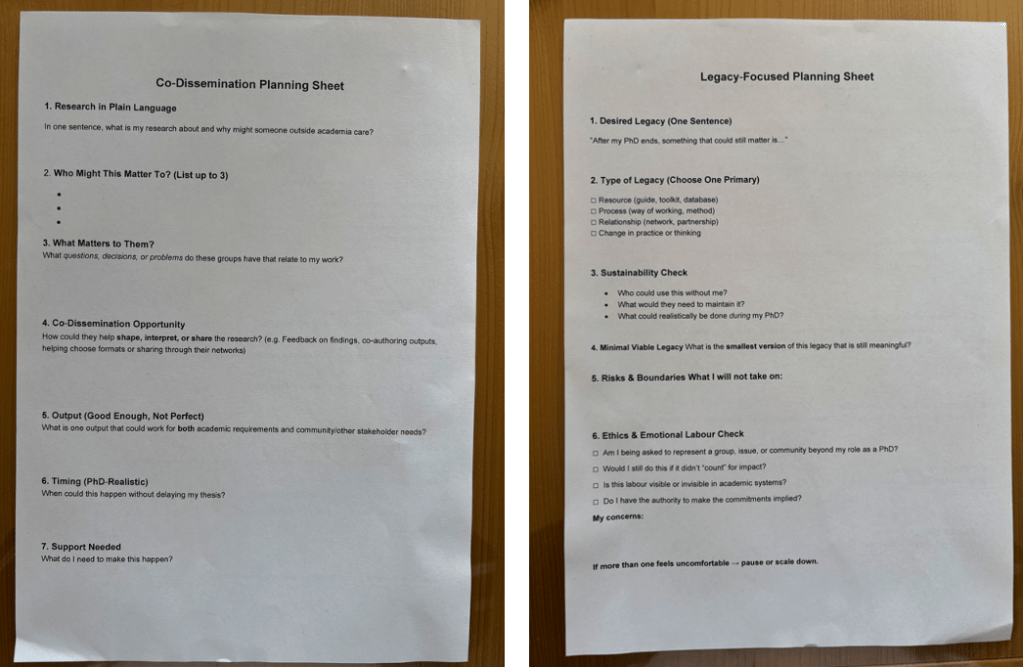
Aimee’s session ended with an interactive activity that allowed group members to reflect on their own research, answer key questions, consider co-dissemination methods, and determine what impact they’d like their research to have. The sheet consisted of two main sections 1. Co-Dissemination Planning Sheet 2. Legacy-Focused Planning sheet, with the following questions:
Co-Dissemination Planning Sheet:
- Research in Plain Language: In one sentence, what is my research about and why might someone outside academia care?
- Who Might This Matter To?
- What Matters to Them? What questions, decisions, or problems do these groups have that relate to my work?
- Co-Dissemination Opportunity: How could they help shape, interpret, or share the research? (e.g., feedback on findings, co-authoring outputs, helping choose formats or sharing through their networks)
- Output (Good Enough, Not Perfect): What is one output that could work for both academic requirements and community/other stakeholder needs?
- Timing (PhD-Realistic): When could this happen without delaying my thesis?
- Support Needed: What do I need to make this happen?
Legacy-Focused Planning Sheet
- Desired Legacy: “After my PhD ends, something that could still matter is…”
- Type of Legacy (Choose One Primary)
- Resource (guide, toolkit, database)
- Process (way of working, method)
- Relationship (network, partnership)
- Change in practice or thinking
- Sustainability Check
- Who could use this without me?
- What would they need to maintain it?
- What could realistically be done during my PhD?
- Minimal Viable Legacy: What is the smallest version of this legacy that is still meaningful?
- Risks & Boundaries: What I will not take on:
- Ethics & Emotional Labour Check
- Am I being asked to represent a group, issue, or community beyond my role as a PhD?
- Would I still do this if it didn’t “count” for impact?
- Is this labour visible or invisible in academic systems?
- Do I have the authority to make the commitments implied?
For the legacy planning sheet, Aimee expressed that “if more than one feels uncomfortable, pause or scale down”.
Aimee noted that the planning sheet may work for some projects or communities more than others, but it is a way of starting the thought process. Members expressed that this activity was extremely beneficial, asking questions they had not considered, which will help them better decide and incorporate dissemination methods.
Toolkit discussion
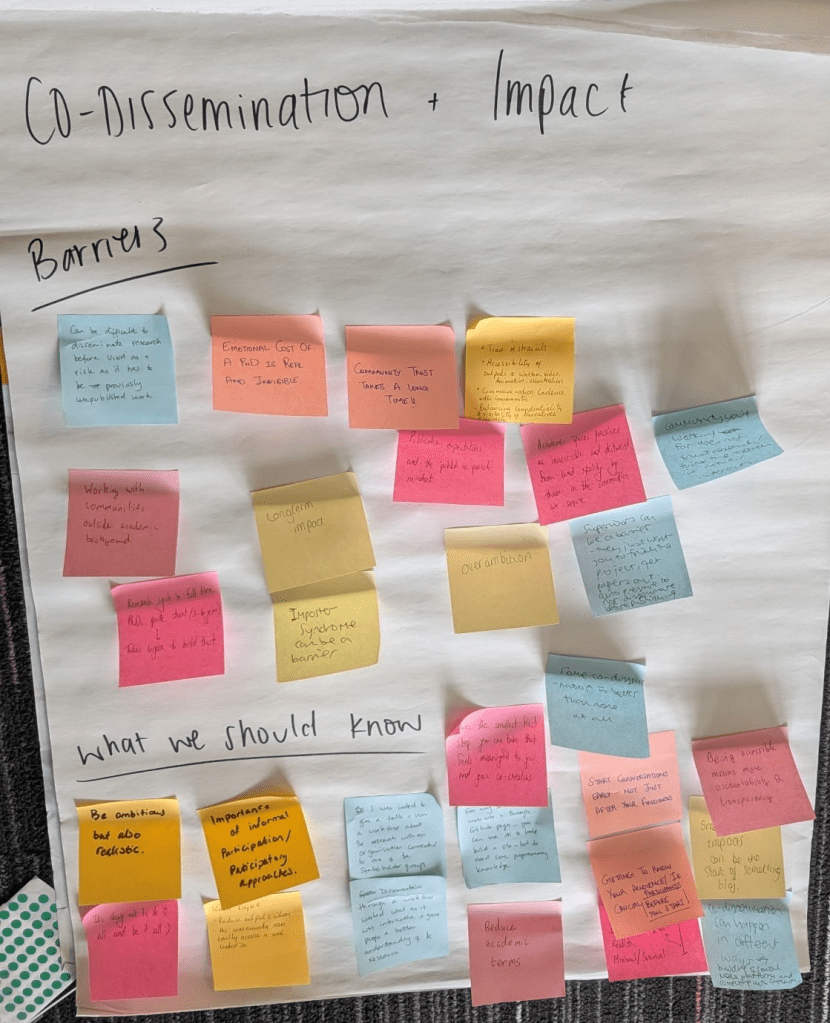
The session closed with group discussions on our toolkit development and key points to highlight regarding co-dissemination. Members identified the following barriers and priorities:
Barriers at the PhD level:
- Building community trust takes time.
- Challenges to co-analysis and dissemination due to accessibility
- It can be difficult to disseminate research before viva.
- The emotional cost of a PhD is real and invisible.
- Academic spaces can be perceived as inaccessible and distorted from the lived experiences of community members.
- Overambition
- Imposter syndrome can make you doubt your abilities.
What students should know:
- Be ambitious but realistic.
- Consider the importance of informal participation/participatory approaches, e.g., use of social media.
- It’s okay to not do it all and be it all.
- Dissemination through workshops can work well, as they are interactive and help people better understand research.
- Reduce academic terms when engaging with community members.
- Do what you can within your means: Some co-dissemination is better than none.
- Start the process and conversations early, not just after findings.
- Get to know your audience before you start.
- A small impact can be the start of something big.
- Co-dissemination can happen in different ways.
- Being accessible means being more accountable and transparent.
Thank you again to Aimee for such a thoughtful session, and to all network members for contributing so openly!


Leave a Reply