


2pm-4pm, 1st April, 2026
Franklin Wilkins Building, King’s College London and MS Teams
Our April session of the PhD Participatory Research Network brought together PhD students from King’s College London, Queen Mary University of London, Imperial College London, Durham University, University of Birmingham, University of Greenwich, Brunel University of London, Royal Holloway University of London, University of the West of England, Edinburgh Napier University alongside guests from the National Coordinating Centre for Public Engagement (NCCPE).
Co-Analysis in Participatory Research: Setting the Scene
This session was led by Zoe Williamson, Head of Services at the National Coordinating Centre for Public Engagement (NCCPE), a national body working to make higher education more accessible and inclusive.
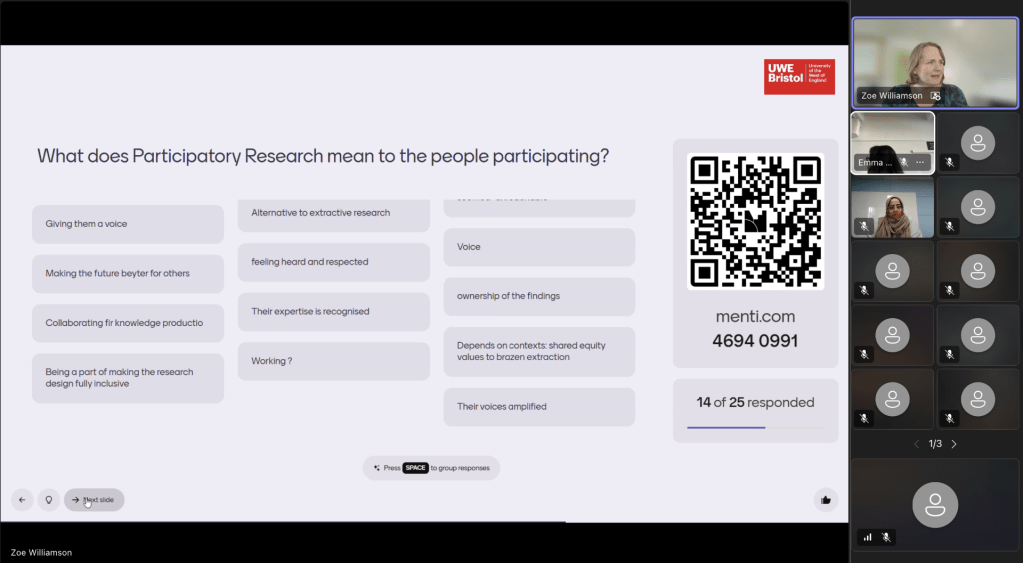
Zoe opened with a Mentimeter activity to explore what participatory research means to the group, what it means to participants, and when co-analysis should begin. The discussion outlined: participatory research looks different for everyone, and it is important to reflect on what it means within your own project before co-analysis.
Key takeaways:
- Participatory research is not one-size-fits-all and approaches vary across projects and communities.
- Starting co-analysis from the very beginning is ideal but may not always be practical within a PhD.
- Being open and honest with participants about commitment, feasibility, and what each party hopes to give and receive is essential.
Planning Your Approach
Zoe introduced a reflective framework for thinking about what researchers can control, what they can influence, and what they have concerns over but cannot control. Network members contributed their own reflections:
- What you can control: the number of meetings with your advisory group.
- What you can influence: the type of training offered to your advisory group, or interactions with partner organisations.
- What you have concern over but limited control: funding constraints, participants’ confidence and willingness to contribute, integrating co-analysis into quantitative approaches, and the tension between PhD timelines and ethical processes.
Zoe also signposted participants to two practical examples of co-analysis:
- Jennings et al. (2018): 10.1186/s12888-018-1794-8
- Seale et al. (2015): https://doi.org/10.1080/13511610.2015.1081558
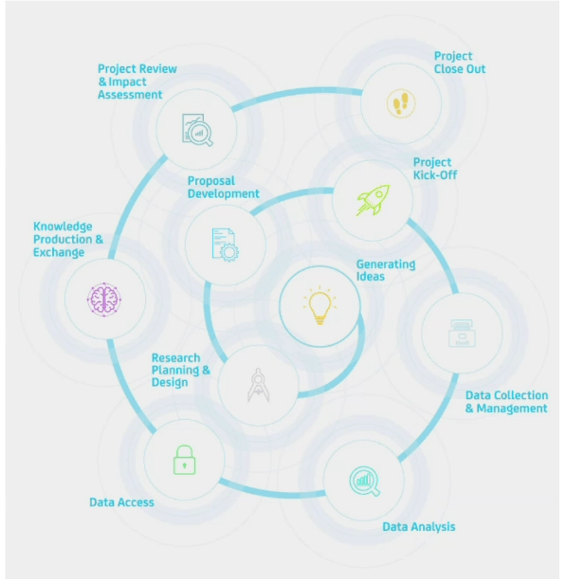
Research Cycle:
Whose Voice Shapes Knowledge? Co-Analysing Trust with Pakistani Women in Nottingham
Amreen Aslam, PhD Researcher within the Collaboratory Programme at the University of Nottingham, shared her experience of evolving her research into a co-analysis approach.
Amreen’s research explores patterns of engagement, cultural context, and trust among Pakistani women. She began with individual interviews grounded in lived experience, using thematic analysis in NVivo for initial theme development. As patterns emerged, she recognised there was missing depth prompting her to introduce focus groups for deeper exploration of different layers of trust. Crucially, this shift was shaped in dialogue with her community supervisors, who helped her identify gaps. Amreen highlighted the value of bringing interpretation back to the community.
Amreen experienced an interruption to her studies while awaiting ethics approval but was able to complete her interviews within three months. Recruitment was smooth due to existing connections with her target population through her work. She underlined the importance of adapting to participants’ needs such as accommodating childcare, holidays, and other commitments.
Reflections from Amreen’s experiences:
- The importance of navigating power dynamics between community participants, supervisors, and the researcher.
- Positionality, including disagreements and what it means to represent someone else’s experiences.
- The role of community supervisors in anchoring co-analysis and providing direction.
- Co-analysis strengthened validity and generated richer focus group questions.
Further reading: Creating Living Knowledge Programme Report
Group Reflections: What Co-Analysis Could Look Like in Our PhDs
Network members shared how they might approach co-analysis within their own projects. A rich range of perspectives emerged:
- Several members are considering working with community advisory groups or panels, sharing quantitative findings to check their lived experience, checking for researcher assumptions, and asking participants how they would like findings to be shared.
- Others are planning thematic co-analysis: working with an advisory panel to discuss codes, cluster them, and interpret themes, both during initial coding and again at the end to validate findings.
- Others raised the complexity of co-analysis within a PhD that still expects the researcher to be the primary knowledge creator and called for clearer guidance on how to explain processes such as thematic analysis to advisory panels in accessible ways.
- A member researching prison healthcare raised important questions around whether participatory approaches might unintentionally contribute to stigmatisation in sensitive institutional contexts and sought guidance on acknowledging contributions from those involved.
- Several members noted that funding is a barrier, with one highlighting that having a small amount to pay lived experience experts had been invaluable and advocating for such support to be built into research proposals from the outset.
Towards a PhD Participatory Research Toolkit on Co-Analysis
The session closed with a collaborative discussion about what should be included in an upcoming PhD Participatory Research Toolkit. Members identified the following priorities for the co-analysis section:
- Checking researcher bias and positionality: being mindful of neurodiversity, insider research, and assumptions brought to analysis — especially when working within communities you are part of.
- Power sharing: proactively thinking through what types of power are present and where they lie, and using frameworks such as the Powercube and NCCPE’s Principles of Partnership Working to surface and address power dynamics.
- Building relationships: using relational approaches, getting to know people before making assumptions, and finding common purpose through tools such as MUPI Purposeful Partnership Cards.
- Training and soft skills: the need for accessible training on analytic approaches, alongside soft skills that are not always formally taught — active listening, facilitating discussions, managing language barriers.
- Technical and administrative support: including recording, transcribing, co-authorship considerations, and the role of placement students or research assistants in supporting co-analysis.
- Representation and consistency: acknowledging the challenge of diverse and consistent representation within PhD time and funding constraints, and being honest about when the same voices risk being over-represented.
You can find resources and discussions on the Participatory PhD Network Padlet.
Thank you to Zoe Williamson and Amreen Aslam for such a thoughtful and generative session, and to all network members for contributing so openly to the discussion!
Next Session
Please see below for upcoming network events.
PhD Participatory Research Network: May Session on Wednesday 6th May, 2-4pm (hybrid)
For this session, we are delighted to welcome three facilitators from The McPin Foundation: Femi, Hanna, and George. Together, they will lead a workshop focused on co-dissemination strategies and ways to create a lasting legacy and real impact within the confines of a doctorate.
This is a hybrid session. Please register using the appropriate link: in-person attendance or online attendance. The Microsoft Teams link will be sent 48 hours before the session.


Leave a Reply